
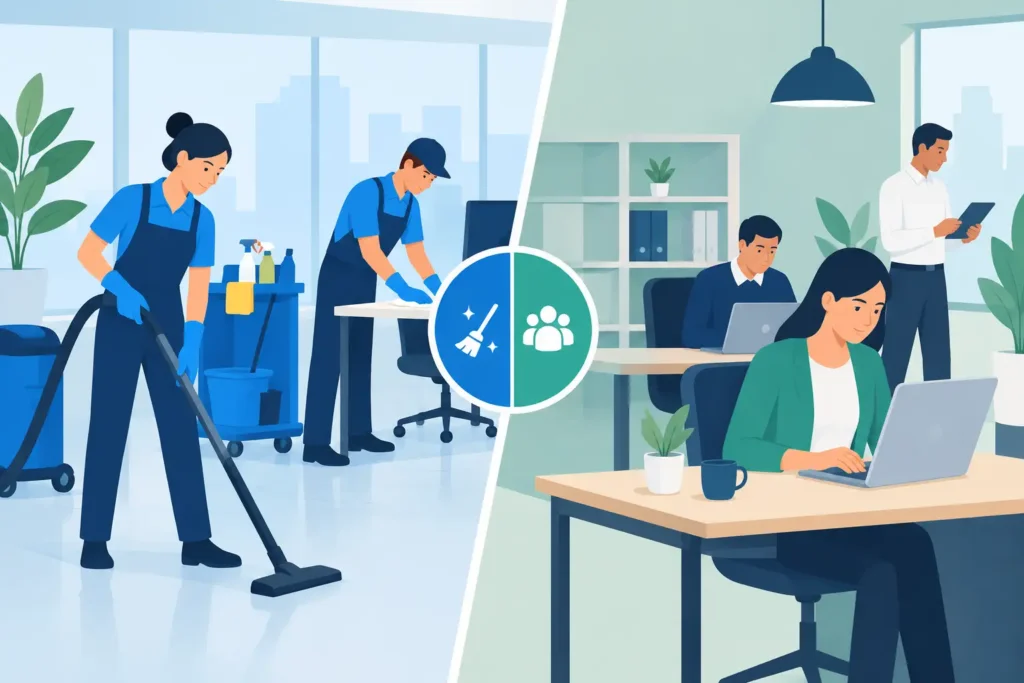
A clean office is not just about appearances. It affects how employees feel when they arrive, how clients view your business, and how easily your team can focus throughout the day. When comparing office cleaning vs in-house staff, the best choice is rarely about who can push a vacuum. It is about finding a dependable way to keep your workplace consistently clean without creating unnecessary cost, stress, or management work.
For Lawrenceville-area businesses, the right answer depends on your facility, operating hours, cleaning needs, and how much flexibility you want. An in-house cleaner can make sense in a few situations. For many offices, though, a professional commercial cleaning partner offers more predictable results with less to manage.
What You Are Really Comparing
The decision is often framed as a simple cost question: hire an employee or hire a cleaning company. But the full picture is broader. In-house staff require recruiting, training, scheduling, supervision, payroll administration, equipment, supplies, and a backup plan when someone is out sick or takes vacation.
A professional office cleaning service is built to handle those responsibilities for you. You agree on the scope of work, frequency, access instructions, and priorities. The cleaning team arrives on schedule, brings the right supplies and equipment, and follows the plan you approved.
That difference matters when you are running a business, managing tenants, or trying to support a busy office team. Cleaning should support your operation, not become another operational burden.
Office Cleaning vs In-House Staff: The Real Costs
An hourly wage is only one part of an in-house employee’s cost. Employers also need to consider payroll taxes, workers’ compensation, benefits when applicable, uniforms, onboarding time, background checks, cleaning products, equipment maintenance, and replacement costs. If the employee leaves, the hiring process starts again.
There is also the cost of coverage. A single in-house cleaner may be reliable and hardworking, but they cannot be in two places at once. If they are sick, on vacation, or unavailable during a particularly busy week, someone still has to handle the cleaning. That responsibility often falls back on office managers or employees who already have full workloads.
Outsourced office cleaning usually works on a clear service agreement or customized quote. You know what work is expected, how often it will be completed, and what you are paying for. A cleaning company also has systems for staffing and coverage, making it easier to maintain service when schedules change.
This does not mean outside cleaning is always less expensive on paper. A very small office with basic needs may find that a part-time employee is workable. The better question is whether that approach remains cost-effective after you account for every responsibility attached to the role.
Control Can Look Different Than You Expect
Some business owners prefer in-house staff because they want immediate access to a cleaner during the day. That can be useful in high-traffic spaces, medical-style environments with frequent touchpoint needs, large facilities, or locations where spills and messes need attention quickly.
However, control is not limited to having a cleaner on-site. With a professional cleaning company, you control the cleaning checklist, schedule, areas of focus, and service frequency. You can request attention to restrooms, break rooms, reception areas, conference rooms, glass doors, floors, or high-touch surfaces based on how your business operates.
A tailored plan also gives you room to adjust. Maybe your office needs nightly trash removal and restroom care but only needs detailed floor work once a week. Maybe client-facing areas need extra attention before Monday mornings, while back offices can follow a different schedule. The right commercial cleaning plan should fit the way your workplace actually functions.
Quality Depends on Training and Accountability
A skilled in-house cleaner can do excellent work, especially when they understand your building and have enough time to complete every task. The challenge is consistency. Cleaning standards can slip when the person is pulled into other duties, lacks proper supplies, or does not have a clear inspection process.
Professional cleaners are trained around repeatable processes. They know how to clean and disinfect common office areas, work efficiently around furniture and equipment, and keep details from being overlooked. A dependable provider also has a reason to protect the relationship through quality checks, communication, and responsive service.
For businesses, visible details matter. Smudged entry doors, overflowing trash, dull floors, dusty vents, and neglected restrooms can quickly change how a workplace feels. Employees notice them. Visitors notice them too. Regular professional service helps prevent those small issues from building into a bigger impression problem.
Flexibility Is Often the Deciding Factor
Your cleaning needs are not always steady. A busy season, special event, office move, renovation, or increase in staff can change the workload quickly. With an in-house employee, a larger cleaning need may require overtime, additional hiring, or asking other team members to fill the gap.
With a commercial cleaning provider, it is generally easier to scale your plan. You may add extra visits, request a deep clean, schedule post-construction cleanup, or adjust service after a move without rebuilding your staffing structure.
This is especially helpful for property managers and growing businesses. Different tenants, changing occupancy, and turnover can create needs that do not fit neatly into one employee’s schedule. Flexible service lets you respond without committing to permanent labor costs before you need them.
When In-House Cleaning May Be the Better Fit
There are situations where in-house staff deserve serious consideration. A large facility that operates around the clock may need someone available throughout the day. Businesses with highly specialized sanitation requirements may also benefit from dedicated personnel with site-specific training.
An in-house arrangement can also work when cleaning is only one part of a broader facilities role. If an employee is already responsible for minor maintenance, room setups, supply stocking, and daily building checks, cleaning tasks may fit naturally into that position.
Even then, it is worth being realistic about the workload. When one person is responsible for everything, detailed cleaning often gets delayed behind urgent repairs and daily requests. Many facilities use a hybrid approach: in-house staff handle immediate day-to-day needs while a commercial cleaning team completes scheduled, thorough cleaning after hours.
When Professional Office Cleaning Makes More Sense
Outsourced cleaning is often the stronger fit for small and mid-sized offices, retail spaces, restaurants, fitness centers, managed properties, and businesses that want reliable results without supervising another employee. It is also helpful when your team prefers cleaning to happen after business hours, so there is less disruption during the workday.
A professional service can be particularly valuable if your current approach is inconsistent. If employees rotate cleaning chores, trash removal gets missed, restrooms are becoming a complaint, or no one knows who is responsible for supplies, your business has already outgrown an informal plan.
UpStraight Cleaning works with commercial clients who want a plan built around their actual space and priorities. Whether you need recurring office care, a one-time deep clean, or support after construction or a move, the goal is simple: give your workplace the polished, cared-for feel your employees and visitors deserve.
Questions to Ask Before You Decide
Start by looking at the areas that affect your workplace every day. How many restrooms, break rooms, workstations, and client-facing spaces need regular attention? How much time does cleaning take now, and who is responsible when the usual person is unavailable?
Then consider the standard you want to maintain. A basic tidy-up is different from detailed recurring service that includes dusting, floor care, disinfecting high-touch areas, cleaning glass, and maintaining restrooms. Be clear about what “clean” means for your business before comparing quotes or staffing costs.
Finally, think about your growth. A cleaning plan should be easy to adjust when your team expands, your schedule changes, or you add another location. The option that feels cheapest this month may not be the one that gives you the most value over the next year.
A clean workplace should feel like one less thing to worry about. Choose the arrangement that gives your team confidence, keeps your space ready for business, and lets you spend more of your time on the work only you can do.

